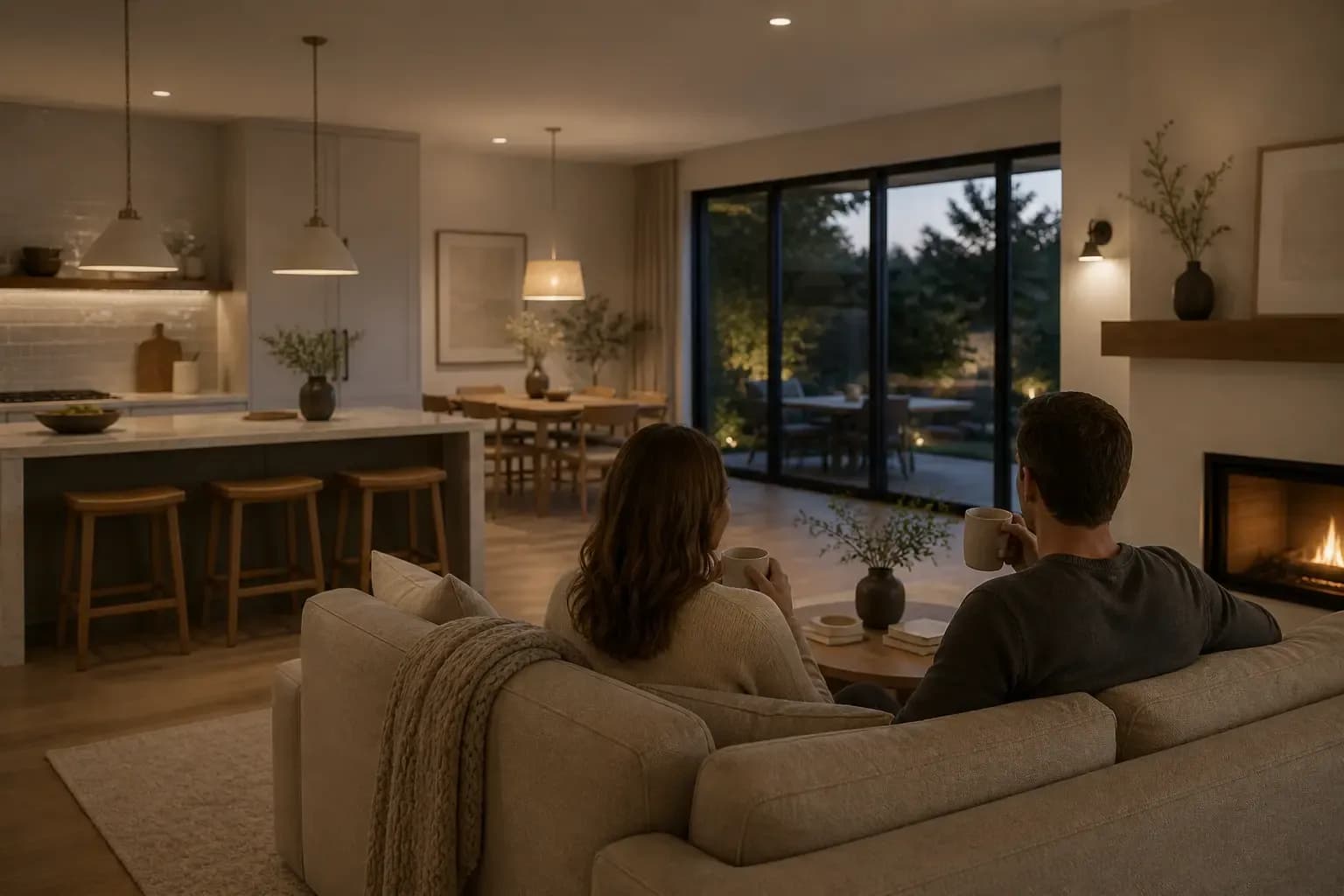
Most conversations around custom homes focus on what happens before move-in. Design decisions, materials, layouts, finishes. But very little is said about what happens after, when the house is no longer a project and starts becoming part of your daily life.
That’s when something shifts. Not just in how the space works—but in how you begin to see it.
You start to notice what supports you. What feels resolved, and what feels like noise. And over time, that awareness changes the way you understand space altogether.
- You Start Noticing Friction. Or the Absence of It
It’s not that the house is doing something dramatic. It’s that it’s no longer getting in the way.
A morning that feels slightly more fluid.
A transition between spaces that doesn’t interrupt you.
A place where people naturally gather—without needing to be called into it.
These moments are easy to overlook, but they add up.
That’s usually the first shift—you begin to notice what was always there, but never fully registered.
- The House Stops Asking You to Compensate
In many spaces, living comes with negotiation.
You walk around furniture that never quite fits.
You avoid rooms that don’t feel right.
You adapt your routines to accommodate the layout.
It’s subtle, but constant.
In a custom home, that relationship tends to reverse. The space aligns more closely with how you live—so you stop compensating for it.
You use more of the house, not less.
Movement feels intuitive.
Nothing asks for extra effort just to function.
It’s not about perfection. There are still imperfections. But the overall experience feels aligned rather than adjusted.
And once you feel that, it becomes difficult to ignore elsewhere.
- Small Decisions Start to Reveal Themselves
The value of a custom home rarely shows up all at once.
It appears in small, almost forgettable moments:
— when a space adapts to a change in routine without needing to be reworked
— when something works the way you hoped it would—even if you barely remember deciding it
— when you don’t find yourself thinking, this could have been better
And most of them trace back to decisions that didn’t feel important when you made them.
Which raises a question most people don’t ask early enough:
What seems small now—but will be felt every day later?
- You Become More Aware of What Actually Matters
One of the less obvious changes is how your attention shifts.
Before, it’s easy to focus on visible elements—finishes, furniture, features. What looks good. What stands out.
But living in a space that’s been resolved differently changes that focus.
You start asking different questions:
Why does this room feel calm?
Why does this one feel slightly off?
What is actually supporting this space—and what is just filling it?
Some things begin to matter more: proportion, light, how materials age, how spaces connect.
Other things start to fade. Details that once felt important begin to feel unnecessary. Sometimes even distracting.
Sometimes removing something doesn’t make the space feel empty—
it makes everything else make more sense.
That’s where the distinction becomes clearer—between what holds the space together, and what is simply noise.
- Your Eye Starts to Change
Over time, something else happens—something less tangible, but more lasting.
You begin to see differently.
Not just in your own home, but in every space you enter.
You start to notice alignment—and just as quickly, when something is slightly off.
You recognize when a space feels resolved, and when it doesn’t.
And more importantly, you begin to understand why.
That awareness doesn’t come from theory. It comes from living in a space where decisions were made with intention—and experiencing the result of them daily.
- Comfort Moves Into the Background
There’s a point where you stop noticing the house altogether.
Light behaves the way you expect.
Temperatures feel consistent.
Noise doesn’t travel in ways that disrupt you.
You’re not constantly adjusting, fixing, or working around things.
And that’s usually when you realize something important:
comfort isn’t something you should have to think about—it should already be there.
When it’s right, it disappears into the background—and lets everything else take its place.
- The Difference Doesn’t Fade
Unlike visual features or trends, this shift doesn’t wear off.
If anything, it becomes more noticeable over time. As life changes, the space either continues to support you—or it doesn’t.
And when it does, you feel it in ways that are hard to point to, but easy to recognize.
Not because everything is perfect, but because it continues to make sense.
- Final Thoughts:
Living in a custom home isn’t just about having something tailored.
It’s about developing an awareness of what truly matters in a space—and what doesn’t.
Over time, that awareness stays with you. It shapes how you make decisions, how you evaluate spaces, and how you define comfort.
And eventually, it becomes less about the house itself— and more about the way you’ve learned to see, and what you’re no longer willing to ignore.