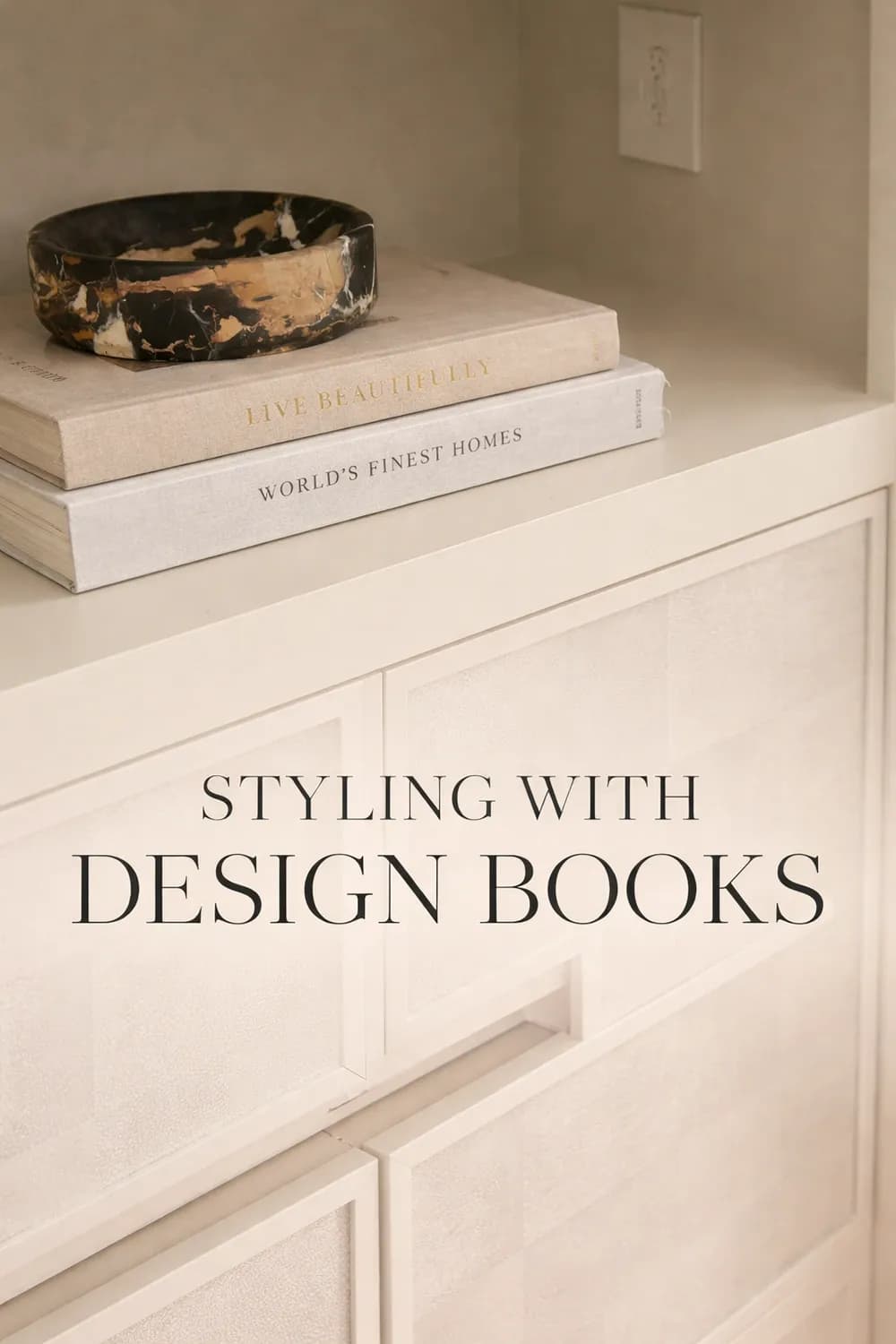
Learning to style a space doesn’t start with buying objects—it starts with learning how to see. The difference between something that looks good and something that feels right often comes down to proportion, alignment, and restraint. Train your eye slowly: study how light moves through a room, how materials interact, how negative space gives weight to what’s left. As Dieter Rams put it, “Good design is as little design as possible.” That idea isn’t about minimalism—it’s about clarity. Every element should have a reason to exist, and more importantly, a reason to stay.
Styling becomes refined when you shift from adding to editing. Instead of asking “what else does this need?”, ask “what can be removed so this reads better?” That’s where intention begins to show. Kelly Wearstler often speaks about layering with purpose—contrast in texture, scale, and form—not for excess, but to create tension and depth. And John Pawson reminds us that simplicity requires rigor; it’s not the absence of elements, but the precision of each one. Over time, this way of thinking builds spaces that don’t rely on trends—they hold their ground because they’re resolved.
On Practice, knowing what you like is a good starting point—but taste without articulation stays vague. The goal is to translate that instinct into something you can see, adjust, and refine. Start by externalizing your ideas. Sketch simple layouts, not to be precise, but to understand relationships—where things sit, how they align, how much space they need to breathe. You’re not drawing furniture; you’re mapping proportion. Even rough diagrams begin to train your thinking, because they force decisions instead of impressions.
At the same time, build the habit of reading spaces. Take a room- your own, or one you admire—and break it down. Where is the visual weight? What anchors the space? What feels unresolved, and why? Try recreating it with fewer elements, or rearranging it on paper before touching anything physically. Over time, this back-and-forth between observation and interpretation sharpens your eye.
As Vincent Van Duysen often emphasizes, good spaces are not accidental—they are reduced to what matters. The more you practice this way, the more your ideas stop being abstract and start becoming decisions you can stand behind.
On Beginning, there’s no clean moment where you feel ready—only the point where you start paying attention and decide to act on it. Your eye develops through use, not certainty. Try things that don’t fully resolve, move elements until they almost work, and sit with the discomfort of not getting it right the first time. That friction is part of the process. You’re not chasing perfection—you’re building sensitivity.
Stay curious about what you respond to and why. Notice what holds your attention, what feels balanced, what feels off. Trust that your instincts will sharpen as you test them against real spaces, real light, real materials. Over time, you’ll begin to recognize your own way of seeing—not as a fixed style, but as a way of thinking. That’s where it starts to become yours.